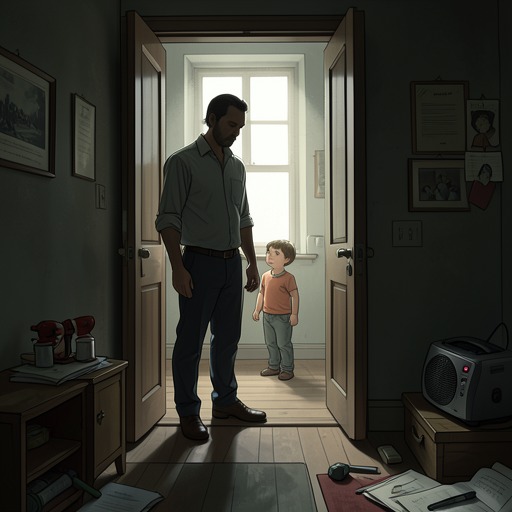
Fire that killed Mike’s grandparents
Cry MachoThe fire that killed Mike Milo’s grandparents is a defining family loss in his past: while he is away at college, a fire destroys the smithy and the house, and both grandparents die. Its force lies not only in the deaths but in the abrupt end of a relationship whose affection had surfaced indirectly, leaving arguments unfinished and tenderness unexpressed.
Background and Family Relationship
Mike Milo’s college years had put distance between him and his grandparents. He had gone to an agrarian college a thousand miles away, taking premedical courses as well as farriery and hippiatry. He returned lonely and unhappy after his first term, but by the end of the first year he had earned excellent grades. College began to look more promising even as home seemed worse, and he proposed modernizing the family saddlery by electrifying its forge.
His suggestion provoked his grandfather, who accused him of growing up too quickly. The narrative identifies that outburst as the closest the old man had come to saying he loved Mike Milo. In retrospect, the exchange gives their practical disagreement an emotional weight neither man had plainly voiced: the proposed change to the smithy is also part of a relationship still negotiating independence, attachment, and change.
The Fire and Its Immediate Aftermath
At the end of his second year, just as he was about to sit his final examination, Mike Milo received a message that the smithy had caught fire the previous night. The house had burned down as well, and his grandparents were dead. The account gives no further explanation of how the fire began. Mike Milo was away from home when it happened and learned of the deaths through the message, making the news arrive at a moment when his college life and family life were still closely bound together.
The narrative moves from the news to the pain of what could no longer be repaired: unresolved arguments, unfinished sentences, and gestures of affection that had not taken place. The loss is therefore presented not as a completed farewell but as an abrupt interruption. What remains is the knowledge that another chance to speak or touch them will not come.
Narrative Significance
The fire makes the earlier exchange with his grandfather newly legible. The old man’s anger had carried an intimacy he could not express directly; after his death, Mike Milo is left to recognize that affection through the words and gestures that did occur, while reckoning with those that did not. The sequence gives the family loss its particular shape: grief is bound to belated understanding and to the irreversibility of ordinary moments.
This private history also stands in sharp contrast with the public image Mike Milo later wears as a rodeo star. At Polk’s Cow Stadium, a large poster presents him as a triumphant cowboy, while his career is framed through competition and the performance of toughness. The fire belongs to a different register of the story, one in which loss cannot be mastered through spectacle or strength. Its continuing significance rests in the silence it leaves behind and in the emotional cost of recognizing love only when its recipients are gone.